Not All Wagers Are Equal: Decoding Game Weighting Before You Claim a Casino Bonus
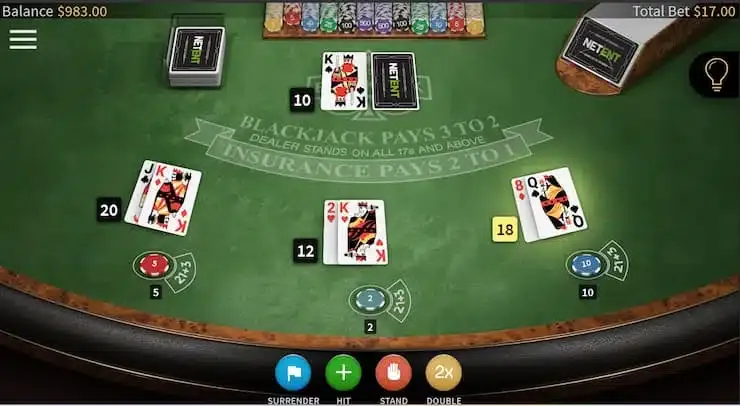
Photo: blackjack table green felt chips cards casino dealer close up, via www.sportstalkphilly.com
You see the banner: $100 bonus, 30x playthrough. You do the math in your head — three grand, done. Then you open blackjack because that's what you actually enjoy, play for an hour, and notice the progress bar has barely twitched. Nothing broke. Nothing was hidden, exactly. You just met game weighting for the first time without knowing it.
Game contribution is the least glamorous line in any bonus terms page, and it's the one that decides whether a promo is a genuine perk or a slow leak. Here's how it works, with the math laid out so you can run it yourself in about two minutes.
The advertised playthrough is only half a sentence
A wagering requirement tells you how many times you must cycle your bonus before withdrawing. It doesn't tell you what counts toward that cycling. That's the contribution rate — usually a percentage attached to each game type.
Slots commonly sit at 100%. Table games get discounted hard: blackjack often lands at 10%, roulette around 20%, video poker somewhere between 10% and 25%, and live dealer games frequently at 10% or excluded altogether. Some sites zero out entire categories — craps, baccarat, certain progressive jackpots.
The reason isn't sinister. Table games have thin house edges and allow skilled players to grind low-risk volume. If a casino counted blackjack at full weight, a competent basic-strategy player could clear bonuses at close to break-even. So the operator discounts your action instead. That's a business decision, and it's fair enough — as long as you know it's happening before you deposit.
The formula worth memorizing
Two lines cover almost everything:
Real dollars to wager = (Bonus amount × playthrough multiple) ÷ contribution rate
Effective multiplier = playthrough multiple ÷ contribution rate
Take a $100 bonus at 30x on the bonus only. At 100% contribution that's $3,000 in handle. At 10% contribution, the effective multiplier becomes 30 ÷ 0.10 = 300x, which is $30,000 in handle. Same banner. Ten times the work.
If the playthrough applies to deposit plus bonus — common on US-facing sites — the starting figure doubles. A 30x on $100 deposited plus $100 bonus becomes 30 × $200 = $6,000 on slots, or $60,000 on a 10%-weighted table game.
Four games, four very different bonuses
Here's the same $100 bonus, 30x on bonus only, run through four typical contribution tables:
- Slots (100%): $3,000 to wager. At a 4% house hold, expected loss is roughly $120 against a $100 bonus. Thin, but the bonus is doing real work.
- Roulette (20%): effective 150x, so $15,000 to wager. At a 5.26% American-wheel edge, expected loss is around $790. The bonus has stopped being a bonus.
- Blackjack (10%): effective 300x, so $30,000 to wager. Even at a friendly 0.5% edge with solid basic strategy, expected loss is about $150 — more than the bonus itself.
- Live dealer (10% or excluded): either $30,000 to wager at a slower hands-per-hour pace, or a promo you simply cannot use.
The lesson isn't that table-game bonuses are scams. It's that the same headline number describes four completely different offers depending on which game you actually intend to play.
House edge is the silent co-signer
Contribution rate tells you how much volume you must generate. House edge tells you what that volume costs. Multiply the two and you get the real price of the bonus.
House edge × total handle = expected cost of clearing.
If the expected cost approaches or exceeds the bonus value, you're not being rewarded — you're paying for the privilege of a progress bar. That doesn't mean you shouldn't play blackjack tonight. It means you shouldn't let a bonus talk you into playing more blackjack than you planned, at stakes you wouldn't otherwise use.
Three tripwires beyond the contribution table
Contribution rates get the attention, but three other clauses routinely change the outcome:
Max bet while wagering. Many bonuses cap each wager at $5 or $10 until playthrough is met. Exceed it and you can forfeit the whole balance. Table players used to spreading $50 a hand get caught here constantly.
Contribution caps. Some terms state that only the first portion of a table-game wager counts, or that table play can satisfy no more than a set dollar amount of the requirement. Read the footnote, not the chart.
Cashout ceilings and deadlines. A bonus may cap winnings at a multiple of the bonus amount, and most playthrough windows run 7 to 30 days. A 300x effective requirement plus a 14-day clock is a different beast than a 30x on slots with a month to spare.
Does this bonus fit how you actually play?
Run the calc, then answer one honest question: would you still want this session if the bonus vanished?
If you're a slots player who was going to spin anyway, a 100%-weighted offer is close to free upside. If you're a blackjack or live-dealer regular, most bonuses are functionally closed to you — and opting in can lock funds you'd rather keep flexible. In that case the cleanest move is to decline the promo entirely and play with your own money under your own rules.
There's also a middle path: claim the bonus, treat the slot requirement as its own separate entertainment budget, and keep your table play uncontaminated by wagering obligations. Two sessions, two purposes, no crossed wires.
A five-minute check before you click opt in
- Find the contribution table. If there isn't one, assume the worst-case weighting.
- Confirm whether playthrough applies to bonus only or deposit plus bonus.
- Note the max bet while wagering, and whether your usual stakes clear it.
- Check the excluded games list for your favorite — live dealer and craps are frequent casualties.
- Run the effective multiplier for your game. Anything above 100x deserves a hard look.
- Note the deadline and the max cashout on winnings.
Six questions, one calculator, and the bonus stops being a mystery box. At Kubett3 Cloud we'd rather you walk into a promo knowing exactly what it costs than find out three hours in, staring at a progress bar that hasn't moved. A bonus that fits your game is a nice head start. A bonus that fights your game is just a longer night with worse odds — and you can always say no to that.